TFT leveling guide: the XP table and when to push
Leveling is the single biggest lever on your board strength, and it is the one most players pull at the wrong moment — either too early on a whim, or too late out of fear.
Your level does two things at once, and conflating them is where most leveling mistakes come from. It sets how many units you can field, and it sets what appears in your shop. Sometimes you want the first, sometimes the second, and they cost the same gold.
The XP table
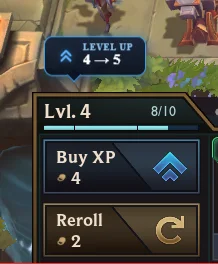
You gain 2 XP free at the end of every round, and can buy 4 XP for 4 gold as often as you like. XP costs exactly one gold each. Hold that conversion in your head and every level becomes a price tag.
| Reach level | XP needed | Free rounds | Gold to buy it outright |
|---|---|---|---|
| 2 | free | — | — |
| 3 | 2 | 1 | 4 |
| 4 | 6 | 3 | 8 |
| 5 | 10 | 5 | 12 |
| 6 | 20 | 10 | 20 |
| 7 | 36 | 18 | 36 |
| 8 | 60 | 30 | 60 |
| 9 | 68 | 34 | 68 |
| 10 | 68 | 34 | 68 |
Look at the shape of that column: 2, 6, 10, 20, 36, 60, 68, 68. Levels are cheap until 6 and brutal after. Getting from 7 to 8 costs more than getting from 1 to 7 combined.
That single number explains almost every economy plan in TFT. "Fast 8" isn't a playstyle so much as an acknowledgement that 60 gold has to come from somewhere, so you'd better not have spent it. And the reason players get stuck at level 7 all through stage 4 isn't indecision — it's that they rolled 30 gold away at 3-5 and can no longer afford the wall.
How XP arrives, and the off-curve tax
Free XP lands at the end of every round, including PvE and carousel rounds. Bought XP comes in blocks of 4. Those two facts create a small, constant tax that good players avoid.
Suppose you need 6 more XP to level. Buying twice gives you 8 — the extra 2 carry over to the next level, so nothing is lost. But suppose you need 2. Buying once gives you 4, and the surplus carries too. So the waste isn't in the XP; it's in the timing. Every round you wait, you get 2 free. If you buy XP on a round where free XP would have levelled you anyway, you paid 4 gold for something the game was about to hand you.
Before buying XP, subtract the 2 you're about to get for free. If that alone levels you, don't buy. If you're levelling to win this round, buy regardless — the round is worth more than the gold.
Level timings
There's no universal curve, but there is a strong central tendency, and it is worth knowing before you deviate from it. Across the 60 comps currently tracked on this site, here is when the winning games actually hit level 8:
A reasonable default curve, to deviate from rather than follow blindly:
| Level | Around | Why there |
|---|---|---|
| 4 | 2-1 | Free. You'll be there on natural XP. |
| 5 | 2-5 | A fifth unit is a large relative gain on a small board. |
| 6 | 3-2 | Board slots to survive stage 3 while you save. |
| 7 | 3-5 to 4-1 | 3-costs peak here at 43%. Reroll comps stop. |
| 8 | 4-1 to 4-2 | 4-costs jump from 10% to 30%. The rolldown level. |
| 9 | 5-1 onward | Only if you're healthy and the game is still going. |
Two honest caveats. If you are on a loss streak with 60 gold at 3-6, you should be early, not on curve — the gold has nowhere better to go and the extra slot buys you health. And if you are at 20 health at 4-1, the curve is irrelevant: level and roll now, because a stronger board next round is worth more than a much stronger board in three.
Level or roll?
The cleanest way to decide is to look at what your gold actually buys at each level. From the odds table:
| Level | 3-cost | 4-cost | 5-cost |
|---|---|---|---|
| 6 | 25% | 5% | 0% |
| 7 | 43% | 10% | 1% |
| 8 | 32% | 30% | 3% |
| 9 | 25% | 33% | 15% |
The decision falls out of the table almost mechanically:
- Rolling for a 3-cost? Stop at 7. 43% is the peak and it drops to 32% at level 8. Levelling actively makes your rolldown worse.
- Rolling for a 4-cost? Level to 8 first. 10% to 30% is a threefold improvement for 60 gold. Thirty gold of rolling at level 7 buys you roughly what ten gold buys at level 8.
- Chasing a specific 5-cost? Only at 9. 3% to 15% is the same shape of jump one level higher, and 9 costs another 68.
Said as one principle: level when the next level is where your units live; roll when you're already standing in the right shop. Nearly all "I rolled 40 gold and hit nothing" stories are someone rolling at 10% odds because they didn't want to spend 60 first.
Level 9 and 10
Level 9 costs 68 XP on top of everything else and gives you a ninth unit plus a real 5-cost chance (15% per slot). It is the correct play in exactly one situation: you are healthy, your board already wins most rounds, and adding a 5-cost would win the rest.
It is the wrong play when you level to 9 hoping it will fix a board that is currently losing. Nine weak units lose to eight strong ones. The ninth slot is a multiplier on a board that already works, not a rescue.
Level 10 is rarer still — another 68 XP, and it's usually reached late in long games or through augments that grant levels. If you get there naturally, the game has gone well; it is not something to plan around.
The uncomfortable version of this chapter. Most players don't lose games by levelling at the wrong stage. They lose by levelling at the right stage with the wrong bank — arriving at 8 on 4-2 with 12 gold because they rolled at 3-6. Leveling and economy are one decision, made two stages apart. Which is why economy comes first in this guide.
You now know when to arrive. Next: what actually happens when you get there — the odds, the pool, and how to run a rolldown without emptying your bank into nothing.