TFT team comps: choosing, flexing and pivoting
Most players pick a comp before the game tells them anything. The better habit is to hold a direction loosely and let items, augments and the lobby narrow it for you.
Forcing versus flexing
Forcing means deciding your comp early and playing it regardless of what the game offers. Flexing means holding a direction loosely and letting items, augments and the lobby narrow it for you.
The argument for flex is arithmetical. Across the 60 comps with a real sample right now, the spread from best to worst average placement is about 1.79 places. The penalty for being the third player on a contested 4-cost carry is larger than that — you'll pay roughly double the gold per copy, and frequently just not get there.
So: the difference between comps is small, and the difference between open and contested is large. Flex play exists to consistently land on the open side of that, and that is the whole justification.
Forcing isn't indefensible. If you're learning, playing one line fifty times teaches you its rolldown, its positioning and its item priority far faster than playing fifty different lines badly. Just know what you're buying: depth now, ceiling later.
What actually picks your comp
Four inputs, roughly in order of how much weight they should carry. Note that "which comp is S-tier" is not on the list.
Your items
The heaviest input, because items are the least replaceable thing you own. Three attack-damage components point at a physical carry; a Tear and two rods point at a caster. Choosing a comp your items don't support means either playing a worse carry or throwing away the components you spent three stages collecting.
Your augments
A trait augment or an emblem is a strong, specific instruction. A prismatic naming a trait is close to a decision made for you. Generic econ and stat augments say nothing about direction, which is exactly why they're safe early picks.
What you've naturally hit
Two copies of a 3-cost you didn't roll for is the game telling you something — that unit is uncontested. Free 2★s are worth more than the theoretical strength of a comp you have no units of.
What the lobby is doing
The tie-break, and often the decider. Two comps look equal on paper; one has three other players in it. Take the other one. This requires actually looking, which is the next chapter.
Stop asking "what comp should I play?" and start asking "what has this game given me?". The first question has one answer per patch and seven other people know it. The second has a different answer every game and is the one nobody can contest you on.
The commit point
Flexing isn't the absence of a decision — it's a decision deferred to the right moment. That moment is around 3-2, when your second augment lands.
Before 3-2 you're gathering: play the strongest board you own, slam flexible items, keep the option open. After 3-2 you're building: your gold and your rolls go toward one line, and you stop buying units that aren't in it.
Committing earlier throws away the information stages 2 and 3 exist to give you. Committing later means arriving at stage 4 — the stage where the game is decided — still buying units for a comp you haven't chosen, with no bank and no board.
"Commit" here means something specific: you know your carry, you know which unit holds your items, and you know what level you're rolling at. If you can't state those three things by 3-5, you haven't committed, whatever you're telling yourself.
Pivoting
A pivot is changing your carry or your core trait after you've committed. It's expensive, it's sometimes correct, and the difference between a good pivot and a bad one is entirely about the trigger.
Pivot when
- You're contested by two or more players. The pool maths has moved against you and no amount of gold fixes it.
- A rolldown failed. You spent 40 gold, you didn't hit, and the pool is emptier than when you started. Continuing is the sunk-cost version of the same mistake.
- An emblem or augment opened something clearly better. A free trait breakpoint can make a comp you weren't playing the strongest board available.
Don't pivot when
- You just lost a round. One round is noise. Check whether you lost to positioning or to strength before you conclude anything.
- Your new comp doesn't use your items. Units are replaceable in one rolldown; six components are not. A pivot that strands your items is usually worse than a bad comp with good items on it.
- It's stage 5. Too late. Refine what you have — positioning, item placement, one more unit upgrade.
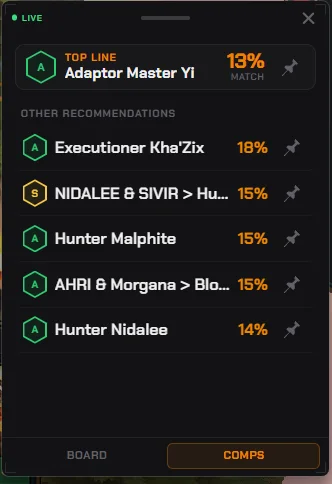
The good pivot is almost always sideways: same items, different holder. You keep the expensive part and change the cheap part. Comps that share a carry type or a core trait are natural pivot partners, which is why the comps pages list each comp's alternates and counters.
How to read a tier list without being misled
Tier lists are useful. They're just not a play order, and treating them as one is why they have a bad reputation among good players.
Here's the top of the current one, as an illustration:





 4.08 S Riftbeast Pebbles

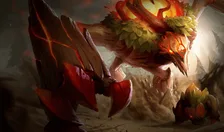
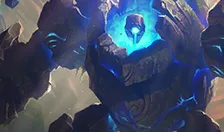
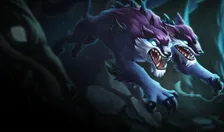
 4.09 S Flora Fatalis Azir



 4.10 S Vanguard Morgana



 4.12
4.12 Three things that list is actually telling you, and one it isn't.
- It tells you what's strong. Genuinely — these comps place well across hundreds of thousands of games.
- It tells you what's popular. High placement and high pick rate travel together, and popular means contested.
- It tells you what to look out for. Knowing the top four comps means knowing what the boards around you are probably becoming.
- It does not tell you what to play. The averages include every game where someone played the comp because the game gave it to them. You copying it from a list at 1-1 is not the same experiment.
A useful habit: read the tier list before you queue, not during the game. Learn the shape of the meta — which carries are contested, which traits are strong, what a 4-2 board should look like — and then play the game in front of you. Opening a tier list mid-game is how you end up third into a comp at 4-1.
You have a board. The next chapter is about the part that costs nothing and is worth a placement: where you put it.