Climbing TFT: LP, consistency and tilt
Everything in the previous chapters is mechanics. This one is about the part that actually decides your rank: doing them consistently, game after game, including the bad ones.
Top 4 before first
Ranked TFT pays LP for the top four and takes it from the bottom four. That's the whole scoring system, and it has a consequence most players resist: the fastest way to climb is to almost never finish fifth.
Compare two players over ten games. One finishes 1st three times and 7th seven times. The other finishes 4th every single game. The second player climbs and the first doesn't, despite having three wins to none. Winning is the most memorable outcome and one of the least important.
In practice this changes decisions at the margin, constantly:
- At 25 health in 5th place, the strongest board you can field right now beats the stronger one you might build. Survival is points.
- When three players are nearly dead, stop taking risks entirely. Top 4 is close to locked; all you can do is lose it.
- A greedy pivot at 4-5 that might win the lobby and might drop you to 6th is a bad trade even at even odds, because the downside is bigger than the upside in LP.
Play for first when you're safely top 4 and the upside is free. That's it.
Variance and sample size
Eight players, eight places, a shared pool and a random shop. TFT has more variance per game than almost any competitive game, and the honest implication is uncomfortable: you cannot tell how you played from how you placed.
Thirty games is a mood. A hundred games is a signal. If you change something about how you play and judge it over fifteen games, you're reading noise and you'll conclude whatever you already believed.
Two habits that help. Track average placement over a rolling window rather than LP — LP mixes your performance with who happened to be in your lobbies. And track top-4 rate alongside it, because the two together tell you whether you're consistent or spiky in a way either alone doesn't.
The lobby average is 4.50. A sustained average of 4.2 over a hundred games is a genuinely strong player. 4.0 is very strong. If your average is 4.6 and you feel unlucky, you are not unlucky — you're 0.1 off the field, which is about one decision a game.
Reviewing your games
Most self-review is useless because people review the wrong games and ask the wrong question. Two corrections fix nearly all of it.
Review your 5ths, not your 8ths
An 8th place is usually a cascade — a bad opening, no items, contested, dead by 4-2. There's nothing to isolate. A 5th place is a game you nearly won, where one identifiable decision was the difference. It is the most instructive result in TFT and the one everyone skips because it isn't dramatic.
Ask where you last had a choice
The wrong question is "what killed me?" — the answer is always "the board that was stronger at 5-2", which teaches nothing. The right question is: where was the last point in this game where I could have done something different? Usually it's two stages before the loss. Usually it's a roll at 3-5, or a comp committed to at 2-1, or an item held for a unit that never came.
A three-question review
Was my economy where I wanted it at 4-1?
You should be able to say the number you intended and the number you had. If they differ by 20+ gold, the game was lost in stage 3 and everything after it was consequence.
Did I commit to the comp the game was offering?
Or the one I wanted? Check your items against your final carry. If they don't match, you forced something.
Did I actually scout before my rolldown?
Be honest. Most failed rolldowns were contested and knowable. If you can't remember checking, you didn't.
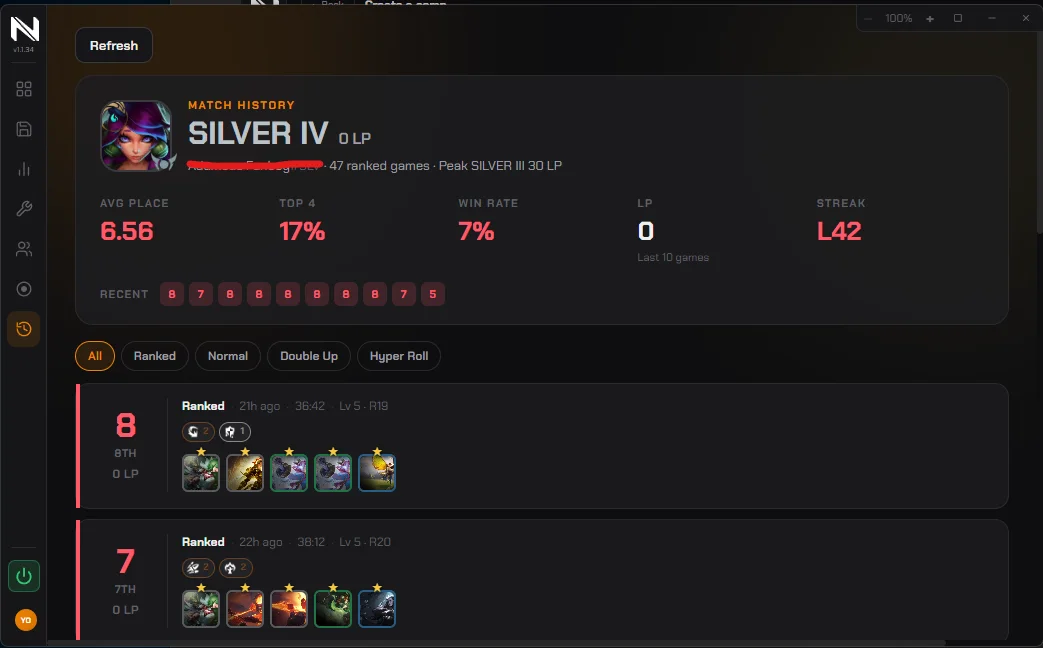
Tilt
Tilt in TFT doesn't look like rage. It looks like speed. You stop scouting, you skip repositioning, you roll without naming a target, you queue again immediately. Every one of those is a decision you'd make correctly if you were paying attention, and you're not.
Which makes it measurable rather than emotional. Three reliable tells:
- You've queued three games in a row without a break. The third is nearly always worse than the first.
- You're picking augments in under five seconds. Not confidence — avoidance.
- You're forcing the comp that lost last game, to prove it works. This is the clearest one and the hardest to notice from inside.
The fix isn't willpower, it's a rule set in advance. Two losses in a row below 5th, you stop for the day or take twenty minutes. Decide that now, while you're calm, because you will not decide it well later.
TFT's variance is genuinely high, which makes "I got unlucky" true often enough to be dangerous. It's a real explanation and a terrible habit, because it's available for every single loss. Use it for individual games and never for a rolling average — over a hundred games, luck is gone and the number is you.
A practice plan
If you want a concrete way to use this guide rather than just having read it:
- Pick one chapter's habit for a week. Not all of them. "Scout before every rolldown" or "never break interest below 50". One thing, every game, until it's automatic.
- Play at least thirty games with it. Fewer and you can't tell whether it helped.
- Review two 5th places a week. Three questions each. Five minutes total.
- Track average placement, not LP. A rolling twenty-game average, written down.
- Then change one more thing. Layering habits works; changing five things at once means you'll never know which one mattered.
That's the guide
Twelve chapters, and the honest summary is that the first three decide most games and the rest decide the ones that are close.
From here, the useful next step is the data rather than more prose: the current meta comps with their boards and item builds, the system tables to keep open while you play, and the champion pages when you want to know what to build on something specific.