
Live
Copies left, counted as you play
Every unit taken by the other seven players comes out of a shared pool. The game never shows you what's left; this sits under the shop and does.
Rank, LP and every game you've played — plus the things a website can't reach: how many copies of a unit are left in the pool, and how good the augment in front of you is for the board you have.
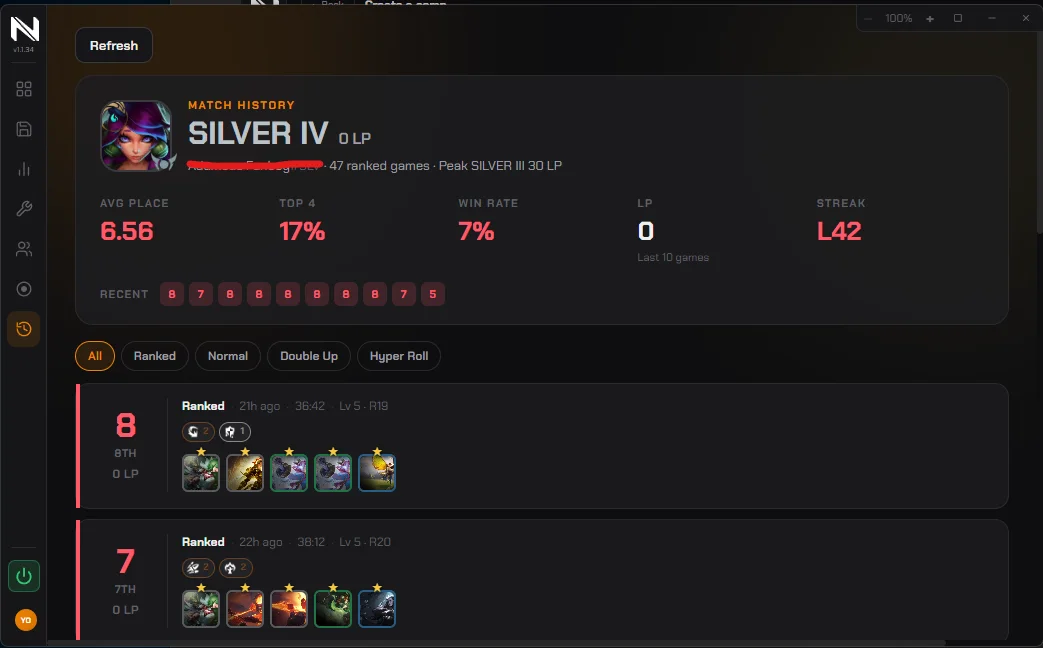
Placement, stage, length and the board you finished with, per game, with the summary line that actually matters on top — average placement, top-4 rate, win rate and your current streak over the last ten. Filter by queue, and look up other players, not only yourself.
Every unit taken by the other seven players comes out of a shared pool. The game never shows you what's left; this sits under the shop and does.
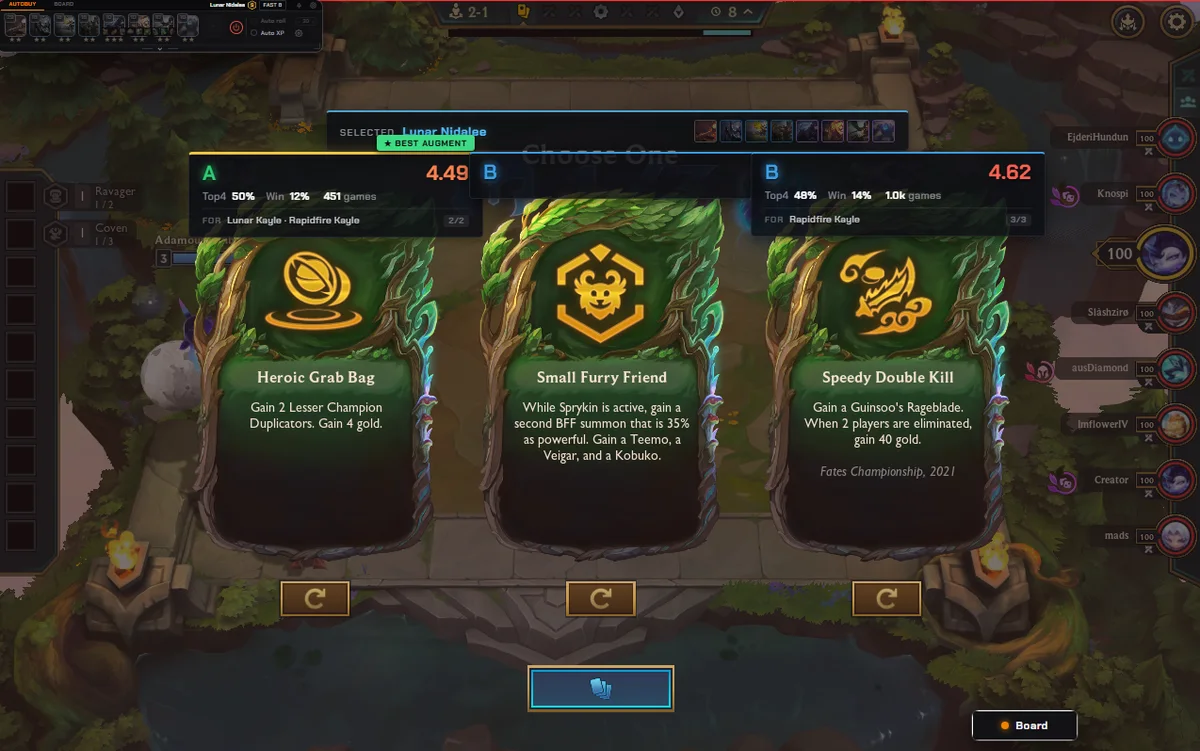
A grade, an average placement and a sample size on each of the three — scored against the comp you're actually playing, while the choice is open.
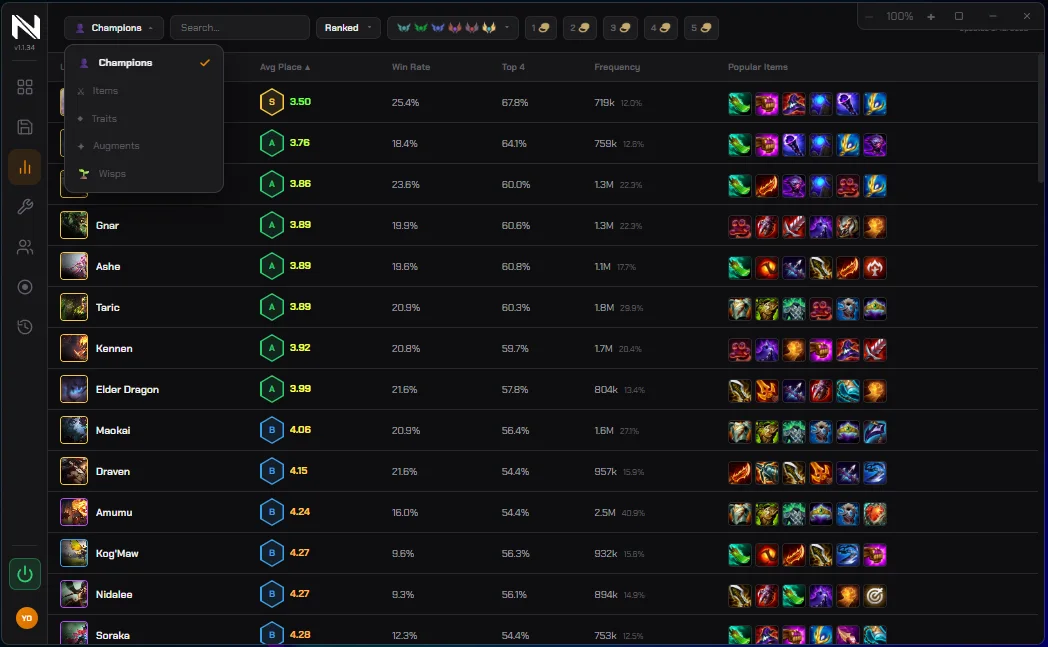
Average placement, top-4, win rate, pick rate and the items people win with — filterable by rank, so you can read the meta at the rank you actually play.
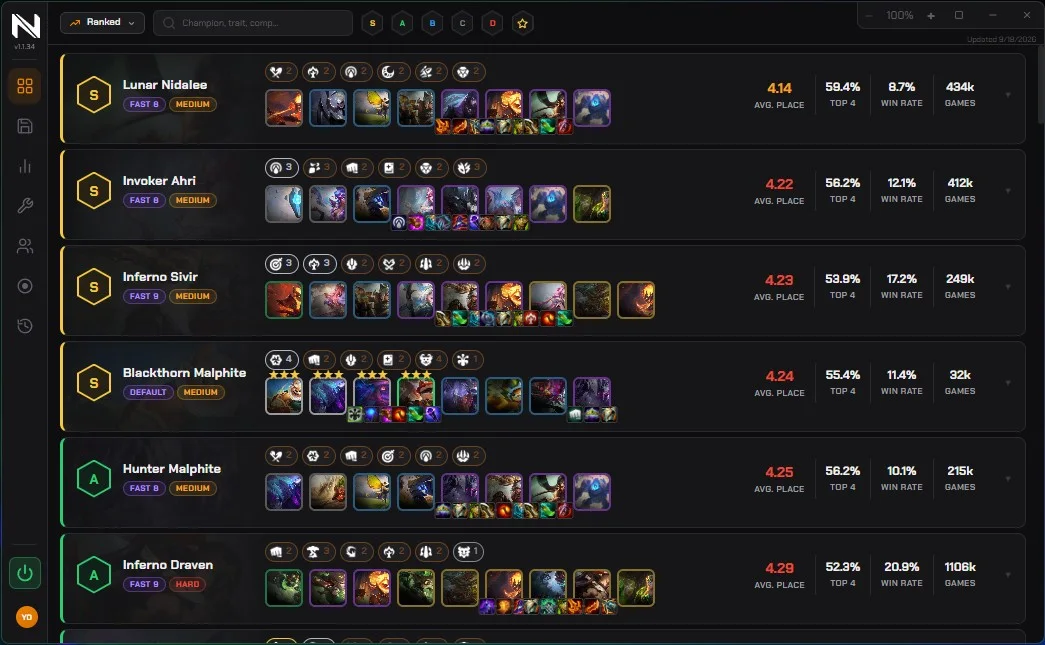
Tier, levelling plan, difficulty, units and items for every composition the ladder is playing — the same data as this site, without the alt-tab.
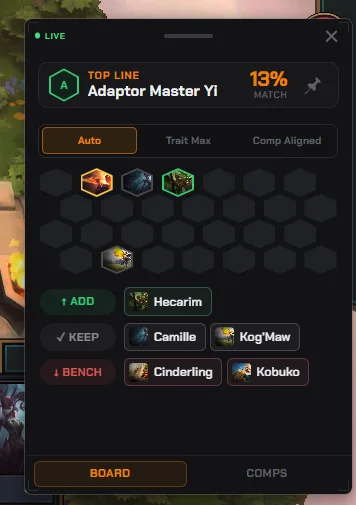
Which comp your board is closest to and by how much, plus what you can still pivot into. Tracking is only worth something if it changes a decision.
The after-the-game half runs in your browser too. Rank, LP history, season placements and the last twenty games with the whole lobby, for any Riot ID.
Almost every TFT tracker is the left column. It is genuinely useful, and several of them are free. The right column is the half that needs a program running on your machine — and it is the half that changes a decision while you can still act on it.
Auto-buy and auto-position are input automation, and Riot's rules neither forbid them in writing nor explicitly allow them. They ship off by default. Our ban rate today is zero, but that depends on a policy Riot can change, and we won't pretend otherwise — every tracking feature above works with them switched off.
A tool that records your Teamfight Tactics games — rank, LP, placements, the boards you finished with — so you can see how you're actually doing rather than how the last game felt. Most are websites you check afterwards. A few, like NoxuTFT, also track the things that only exist during a game: how many copies of a unit are left in the pool, what the other seven boards look like, and how good the augments in front of you are for your comp.
Yes. Sites like tactics.tools and LoLCHESS track your match history for free, and they're good at it. What none of them do is run while the game does: pool counts, augment grades and positioning all have to happen inside the round, and that needs a program on your machine rather than a page in a browser.
Showing information the game already gives you is broadly accepted, and NoxuTFT never reads game memory. Riot's own API is what match-history sites are built on. Input automation — anything that clicks for you — is a grey area Riot has not ruled on in writing, which is why those features ship disabled.
Yes — that is what the NoxuTFT app is. It runs during the game and tracks the live state a website can't see: copies left of every unit in the pool, the augment choice graded for your board, and what the other seven players are building. Match history sites only update once the game is over.
Type your Riot ID (name#tag) into the lookup on this page. It shows your rank, LP history, placement spread for the season and your last twenty games with the full lobby for each — free, in the browser, no download.
Yes. Match history takes any summoner, not just the account you're signed into, so you can look up an opponent or a friend before or after a game.
Match history filters by queue — Ranked, Normal, Double Up and Hyper Roll — so the record covers all of them. The statistics and comps in the app are ranked-queue data; Double Up comps are on this site at /tft-double-up.
